



How to Create Retirement Income from a Business | GIS Tucson
For many Tucson entrepreneurs, a closely held business represents a substantial concentration
of net worth, yet this accumulated wealth remains entirely confined within illiquid equity.
Understanding how to create retirement income from a business requires moving beyond basic
personal savings models. Instead, founders must design a structured architectural framework
that coordinates a clean operational exit with long-term, sustainable cash flow needs.
Transitioning away from active day-to-day operations to passive income structures requires
balancing strict corporate asset valuations, corporate tax regulations, and the mechanical timing
of equity harvesting.
A coordinated business exit strategy serves to replace structural fragmentation with an
integrated approach to business succession and long-term asset preservation. Rather than
viewing an exit as a singular, panicked transaction, owners within the Southern Arizona
ecosystem can utilize structured paths—such as internal transitions, Employee Stock Ownership
Plans (ESOPs), or strategic corporate asset restructurings—to establish stable, long-term
streams of income. This technical guide details the essential mechanics and tax stewardship
frameworks necessary to convert illiquid business value into sustainable retirement cash flow.
Understanding the Illiquidity Trap: Navigating Equity Lock-In
Many entrepreneurs in the Southern Arizona landscape consider their corporate entity to be
their primary retirement vehicle, yet they frequently encounter the severe structural realities of
the illiquidity trap. This scenario occurs when an owner's net worth is highly significant on
paper, but actual personal liquidity is restricted because capital is tied up in equipment,
inventory, commercial real estate, and operational goodwill. Relying on an un-diversified asset
base subjects an owner's retirement timeline to intense corporate and market volatility, meaning
that forced exits during economic contractions can drastically reduce the final realized value of
corporate equity.
Standard qualified retirement structures often present annual contribution limits
that fail to match the massive wealth-harvesting needs of high-net-worth business owners. For
example, according to the official Internal Revenue Service (IRS) Contribution Limitations,
maximum compensation thresholds restrict the scale of traditional plan
contributions. Transitioning from rapid business growth to systematic capital preservation
requires a distinct operational shift, turning away from active gross revenue metrics and moving
toward the structural stability of passive distributions that remain insulated from daily
corporate risk.
The Disconnect Between EBITDA and Personal Cash Flow
A healthy Earnings Before Interest, Taxes, Depreciation, and Amortization (EBITDA)
calculation does not automatically equate to a fully funded personal retirement. Operational
profitability and personal liquidity rely on entirely separate structural metrics. While a firm may
generate consistent revenue, extracting that value requires a deliberate exit architecture that
incorporates formalized Business Valuation Methods. Without clear structural oversight, owners
risk miscalculating their true net walk-away position after all corporate liabilities and
outstanding tax obligations are fully satisfied.
Quantifying the Income Replacement Gap
Calculating a Tucson business owner's retirement income gap requires a detailed analysis of
current corporate distributions compared against projected passive income streams. This
calculation must account for inflationary factors, healthcare allocations, and broader
macroeconomic trends. Conducting a thorough corporate readiness assessment allows owners
to determine if the business infrastructure can withstand an equity transition without
destabilizing core operations, ensuring a predictable foundation for the next financial chapter.
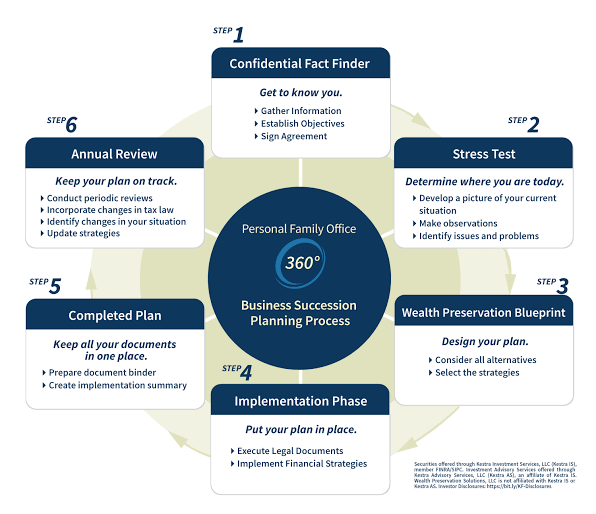
The Structural Pillars of Coordinated Succession Planning
Achieving long-term financial independence requires an integrated approach that coordinates
separate financial strategies into a single, cohesive architecture. The complex process of how to
create retirement income from a business often faces friction when owners manage tax
positioning, succession timing, and estate preservation as completely isolated silos. A
synchronized approach integrates these components to preserve accumulated wealth and limit
the structural inefficiencies common to fragmented decision-making.
The stability of a transition plan relies heavily on the technical tools used to support it.
Corporate buy-sell agreements, structured corporate stock redemptions, and specialized
insurance vehicles can serve as structural stabilizers to provide liquidity during a transition
without interrupting operational momentum. These tools operate at maximum efficiency only
when placed within a broader tax stewardship framework that aligns personal distribution
requirements with corporate succession timelines.
Managing the Succession Tax Trap
A business exit is a complex structural transition where corporate tax liabilities must be
managed through precise timing. Without systematic coordination, owners frequently encounter
significant tax liabilities upon the transfer of corporate equity. Aligning succession timelines
with personal income requirements helps manage these liabilities, allowing owners to
systematically move from active operational oversight to a structured model of corporate equity
harvest.
Maintaining Architectural Alignment across Assets
An optimized retirement plan functions like a balanced structural framework where every
component must support the total financial load. If an estate plan runs counter to immediate
liquidity needs, the stability of the entire transition is compromised. At Global Investment
Strategies, primary contacts Doug McClure and Jay Clifford focus on managing these
complexities, providing the technical coordination required to ensure a business transition
reflects an owner's professional milestones. For owners seeking to move past disconnected
strategies, a model of coordinated retirement planning provides the clarity needed to preserve a
professional legacy. Entrepreneurs looking to establish a secure transition baseline should
review the foundational principles of our GIS Business Succession Framework to align their
timelines effectively.
Strategic Exit Paths: Converting Corporate Equity to Cash Flow
The transition of corporate equity into liquid, income-producing structures represents a critical
phase in an entrepreneur’s financial timeline. Industry data indicates that a significant
percentage of closely held firms lack a formalized, written succession plan, leaving owners
vulnerable to unstructured, reactive exits. To manage this risk, owners must evaluate which
strategic path—whether a third-party sale, family succession, or internal equity transfer—best
coordinates with their cash flow and legacy goals.
A gradual transition of operational control often preserves corporate cash flow more effectively
than an abrupt exit. Utilizing structured vendor financing or installment notes under IRS
Installment Sale Guidelines can help facilitate this shift by converting a portion of business equity
into a stream of private, contractually backed payments. This structure helps secure a reliable
income baseline while allowing new leadership to maintain the entity's commercial momentum.
The ESOP Model: Capital Liquidity and Corporate Continuity
Employee Stock Ownership Plans (ESOPs) represent a sophisticated mechanism for business
owners in the Tucson commercial ecosystem who are seeking liquidity while maintaining
corporate continuity. An ESOP establishes an internal, qualified corporate buyer for company
shares, often minimizing the need for outside financing. For the departing owner, a properly
structured sale to an ESOP can offer notable tax advantages, including the deferral of capital
gains tax under specific code sections, providing a liquid foundation to support long-term
personal distribution strategies.
Internal Succession Architecture and Funding Mechanics
When an outside sale is not the primary objective, executing a successful internal or familial
succession requires strict structural management. Cross-purchase or entity-redemption buy-sell
agreements must be clearly defined and adequately funded to remain enforceable. Utilizing
permanent insurance funding structures or corporate sinking funds can provide the necessary
capital to execute these transfers smoothly, protecting the underlying value of the company and
ensuring an uninterrupted source of retirement cash flow for the departing founder. Owners can
reference our detailed breakdown on GIS Retirement Income Mechanics to coordinate these
internal funding pools with their personal liquidity requirements.
Disclaimer: The material provided in this article is compiled strictly for educational and informational purposes. Global Investment Strategies (GIS) is a financial services firm and is not a fiduciary entity. GIS does not function as an attorney, legal counsel, or professional Tax Advisor. Financial asset structures and exit path optimizations should be evaluated alongside qualified legal or tax professionals to verify alignment with individual regulatory scenarios.