


One of the Most Misunderstood Topics in Retirement: Annuities
One of the Most Misunderstood Topics in Retirement: Annuities
Written by Jay Clifford, Vice President, Global Investment Strategies – Tucson, AZ
Educational only. Not tax, legal, or individualized investment advice. Please review decisions with your own qualified professionals.
Why annuities are so misunderstood
When people start talking about retirement, few words trigger stronger reactions than “annuity.” Some people believe annuities solve everything. Others believe they should never be used under any circumstance. The reality is usually somewhere in the middle (Fidelity - 5 common annuity myths).
At Global Investment Strategies, we see annuities as one possible tool in a retirement income plan — not a magic solution and not a villain. Like any tool, the important question is not “Are annuities good or bad?” but “What is this specific annuity designed to accomplish for you?”
What an annuity is actually designed to do
At its core, an annuity is a contract with an insurance company. In exchange for a premium, the insurer offers certain guarantees. Depending on the design, an annuity might help with:
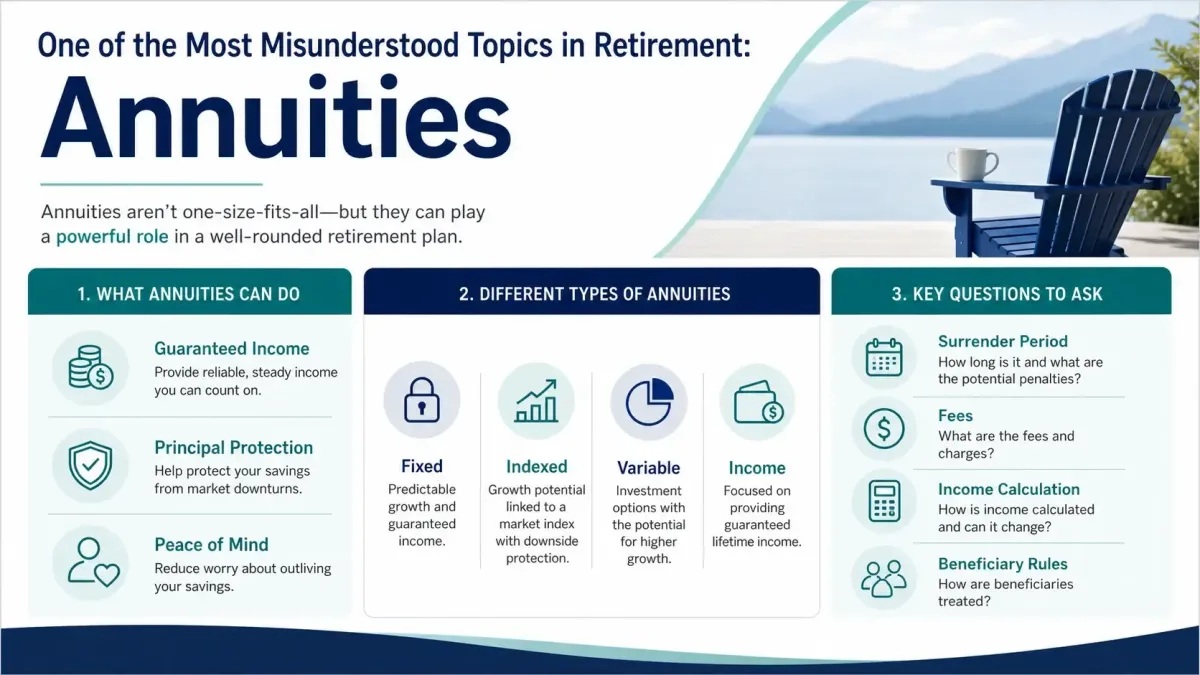
Dependable income you can’t outlive – turning part of your savings into a predictable, lifetime paycheck.
Principal protection from market volatility – in some structures, protecting a portion of your retirement assets from large market swings.
Peace of mind– for some families, simply knowing there is a guaranteed income floor makes it easier to live with normal portfolio ups and downs.
None of these features make annuities automatically right or wrong. They simply describe what the contract is built to do. The key is aligning the tool with the specific job you’re asking it to perform in your retirement plan.
Not all annuities are created equal
One reason annuities are so confusing is that a single word covers several very different products. Each type works differently and has its own strengths, risks, liquidity rules, and fee structures (RetireGuide – Annuity Riders / Types).
Common annuity types
Fixed annuities – offer a stated interest rate for a set period, more like a certificate of deposit issued by an insurance company.
Fixed indexed annuities – link potential interest to a market index with downside protection but limited upside; often used for principal protection plus some growth potential.
Variable annuities – invest in subaccounts similar to mutual funds; values go up and down with the market, and you can lose principal.
Income annuities (immediate or deferred) – focus on turning a lump sum into a stream of guaranteed income for life or a set period. (immediate or deferred) – focus on turning a lump sum into a stream of guaranteed income for life or a set period.
Because the designs and guarantees differ so widely, blanket statements about “annuities” are usually misleading. What matters is which type you’re looking at, how it works, and whether it fits your specific situation.
Why the conversation should start with you, not with a product
We don’t believe the conversation should ever start with, “I have an annuity to sell you.” It should start with you.
Useful questions to ask before you ever look at a contract include:
\What are your primary goals in retirement?
What concerns keep you up at night?
Are you worried more about market risk, running out of income, inflation, taxes, long-term care costs, or something else?
Is leaving something behind for family or charity important to you?
Those answers matter. For example:
Someone with strong pension and Social Security income might not need additional guaranteed income, but may care more about legacy or long‑term care.
Someone with most of their wealth in market accounts and no pension may want to dedicate a slice of assets to contractual lifetime income, so basic expenses are covered regardless of market performance.
When you start with real goals and concerns, it becomes easier to see whether a specific annuity is genuinely helpful or whether another approach fits better.
Key questions to understand before buying any annuity
Because annuities are legal contracts, it’s important to understand the rules clearly before you sign. Here are some of the questions we encourage families to ask and get answered in plain language:
Access and time commitments
How long is the surrender period?
How many years would you face surrender charges if you withdraw more than the “free” amount in a given year?What access do I have to my money?
How much can you take out each year without penalties, and are there exceptions for things like health events or nursing home care?
How income and costs work
How is income calculated?
If the annuity includes a lifetime income feature, what formula does it use to calculate your payment, and how does that change with age or timing?
If the annuity includes a lifetime income feature, what formula does it use to calculate your payment, and how does that change with age or timing?Are there fees?
Are there ongoing rider charges, mortality and expense fees, or underlying investment expenses? How do those costs compare to the guarantees you receive?
Inflation and beneficiaries
How does inflation affect future income?>
Are payments level, can they increase, or are there step‑up features? What happens if inflation is higher than expected over time?What happens to beneficiaries?
If you die earlier than expected, what does your spouse or family receive? How are beneficiaries named, and what options (single life, joint life, period certain) are available?
The big picture question
How does this fit into the larger retirement strategy?
Is this annuity meant to cover essential expenses, discretionary lifestyle spending, long‑term care risk, or legacy goals? What percentage of your total assets is it using?
If you can’t answer these questions in straightforward language, it’s usually a sign to slow down and seek more clarity before moving forward.
Where an annuity may fit in a retirement income plan
An annuity should be one possible building block in your retirement income plan, not the entire plan.
In some cases, that might look like:
Using an income annuity to help cover essential expenses along with Social Security, so that housing, food, and basic healthcare are on more predictable footing.
Reducing “sequence‑of‑returns risk” by using guaranteed income to support early‑retirement spending, so you’re less forced to sell investments in down markets.
Supporting a spouse by structuring joint‑life benefits or survivor options that continue income if one spouse dies first.
In other cases, an annuity might not be the best tool at all. For some families, flexibility, liquidity, and other strategies are more important than contractual guarantees. The goal is not to fit an annuity into every plan, but to see clearly whether it improves yours.
A planning philosophy focused on structure and clarity
At Global Investment Strategies, our retirement planning approach is built around structure and clarity, not pressure.
We encourage families to:
Slow down the decision-making process.
Ask thoughtful, sometimes difficult questions.
Look at how all the pieces of their financial life work together — investments, income sources, insurance, tax planning, and estate documents.
An annuity may or may not be appropriate for you. When it is, it’s usually because it solves a specific problem you’ve identified: providing lifetime income, reducing exposure to market risk for a portion of your assets, or creating a more predictable floor of retirement income.
Sometimes the most helpful step is not buying anything new, but simply getting a second opinion on what you already own and how it behaves under different scenarios.
Important notes and next steps
This article is intended to be educational. It does not replace individualized advice. Annuity contracts are complex, and the specifics vary widely by company and product. Before purchasing, exchanging, or surrendering any annuity, it’s important to review:
The full contract language.
Tax implications for your situation.
Coordination with your broader retirement, tax, and estate plans.
Working with a fiduciary advisor who will explain both benefits and trade‑offs in plain language can help you make more confident decisions about whether — and how — annuities belong in your retirement strategy.
This article is for educational purposes only and is not tax, legal, or individualized investment advice. Please consult your own attorney, tax professional, and financial advisor before making decisions.