


Pima County Business Equity & Real Estate Transitions | GIS
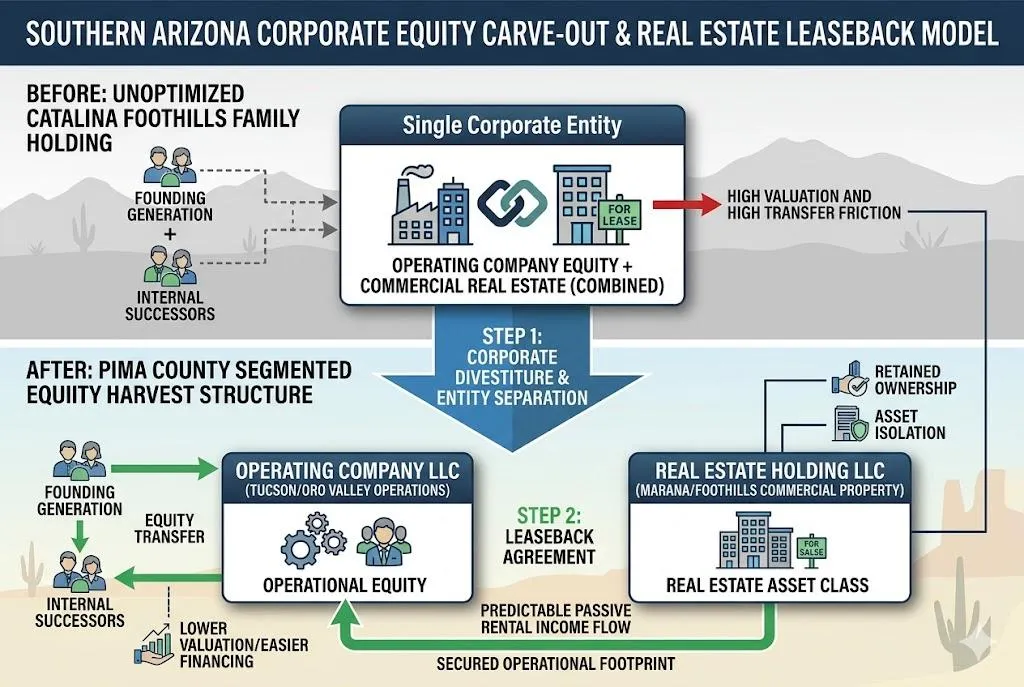
For high-net-worth families anchored in the Catalina Foothills, Oro Valley, and Marana, corporate wealth is frequently divided between active business operations and the underlying commercial real estate. Over decades of regional expansion, the market value of the physical property—whether an executive medical complex off Innovation Park Drive or a specialized facility in the Marana industrial corridor—often grows to dwarf the net value of the operating enterprise itself. When transitioning leadership or preparing for an eventual third-party exit, leaving these distinct asset classes bound within a single corporate entity introduces severe structural inefficiencies.
Unlocking this locked wealth requires a sophisticated understanding of localized asset harvesting. If a corporate entity is transferred or liquidated as a single combined unit, the inflated real estate value can artificially distort the business's valuation metrics, triggering unnecessary capital gains exposures and complicating the entry of internal successors. Navigating this environment demands a deliberate separation of concerns, isolating operational equity from real property to preserve capital and establish independent, predictable retirement income streams.
Isolating Commercial Real Estate via Structured Corporate Divestitures
The primary mechanism for mitigating the valuation cliff in Southern Arizona is the execution of a tax-delayed corporate division or equity carve-out. By systematically carving the real estate holdings out of the primary operating company into a standalone limited liability structure, business families can completely decouple the property's value from daily operational risks. Property valuations must align perfectly with local assessment baselines, which can be monitored directly through the Pima County Assessor to ensure compliance with regional commercial property tax records. This structural insulation allows the founding generation to retain ownership of the physical land and buildings, providing a continuous source of passive rental income backed by the business operations.
This strategic division directly addresses the strict limitations embedded in traditional qualified retirement vehicles, which cannot accommodate the scale of wealth concentrated in regional commercial holdings. According to the foundational parameters outlined in the Internal Revenue Service (IRS) Contribution Limitations, standard personal wealth structures are heavily restricted by annual dollar caps. Shifting the commercial real property into an independent leasing node allows high-net-worth founders to bypass these contribution limits, establishing contractually secured cash flow independent of the operating company’s future equity transactions.
Mitigating Transfer Friction in Oro Valley and Marana Enterprise Corridors
When the operating company is separated from the physical real estate, the transition of the business to key employees or family members becomes significantly more achievable. Successors can purchase or inherit the operational enterprise at a valuation aligned strictly with cash flow and inventory, rather than being forced to finance an expensive real estate acquisition simultaneously. Furthermore, businesses must ensure their entity transitions remain in good structural standing by updating their corporate filings through the Arizona Corporation Commission . Meanwhile, the founding family transitions into a stewardship role, maintaining long-term equity control over the real estate asset class while drawing reliable lease distributions.
Coordinating the Equity Harvest with Cross-Purchase Frameworks
To secure the long-term viability of both the real estate holding entity and the operating business, the transition framework must incorporate structured cross-purchase agreements. When a third-party sale or immediate internal buyout is not the primary objective, utilizing structured vendor financing or installment notes under IRS Installment Sale Guidelines can facilitate a smooth equity transition. These legal and financial structures ensure that if unexpected operational disruptions occur within the Pima County commercial ecosystem, predefined funding mechanisms are triggered to protect the continuity of the lease matrix. This technical coordination prevents localized market contractions from destabilizing the family's broader wealth preservation blueprint.
Synchronized Asset Stewardship for High-Net-Worth Southern Arizona Families
Achieving a seamless equity harvest across separate asset classes requires moving far beyond fragmented financial products. True wealth preservation is achieved by aligning the timing of corporate restructurings with long-term personal distribution requirements. When tax stewardship, property management, and corporate succession planning are treated as interconnected variables rather than isolated tasks, families can successfully insulate their total net worth from structural erosion during a leadership transition.
The operational health of a succession plan depends entirely on the technical precision applied during the initial structural phase. At Global Investment Strategies, primary contacts Doug McClure and Jay Clifford focus on managing these exact operational complexities, providing the comprehensive financial coordination required to navigate these complex corporate asset divisions, ensuring the transition matches your exact timeline. Business owners across the Tucson basin seeking to establish a verified baseline for their corporate transition can review the structural mechanics detailed within our active GIS Retirement Planning Framework.
Disclaimer: The material provided in this article is compiled strictly for educational and informational purposes. Global Investment Strategies (GIS) is a financial services firm and is not a fiduciary entity. GIS does not function as an attorney, legal counsel, or professional Tax Advisor. Financial asset structures and exit path optimizations should be evaluated alongside qualified legal or tax professionals to verify alignment with individual regulatory scenarios.