



Management Buyout vs ESOP: Internal Exit & Continuity Frameworks
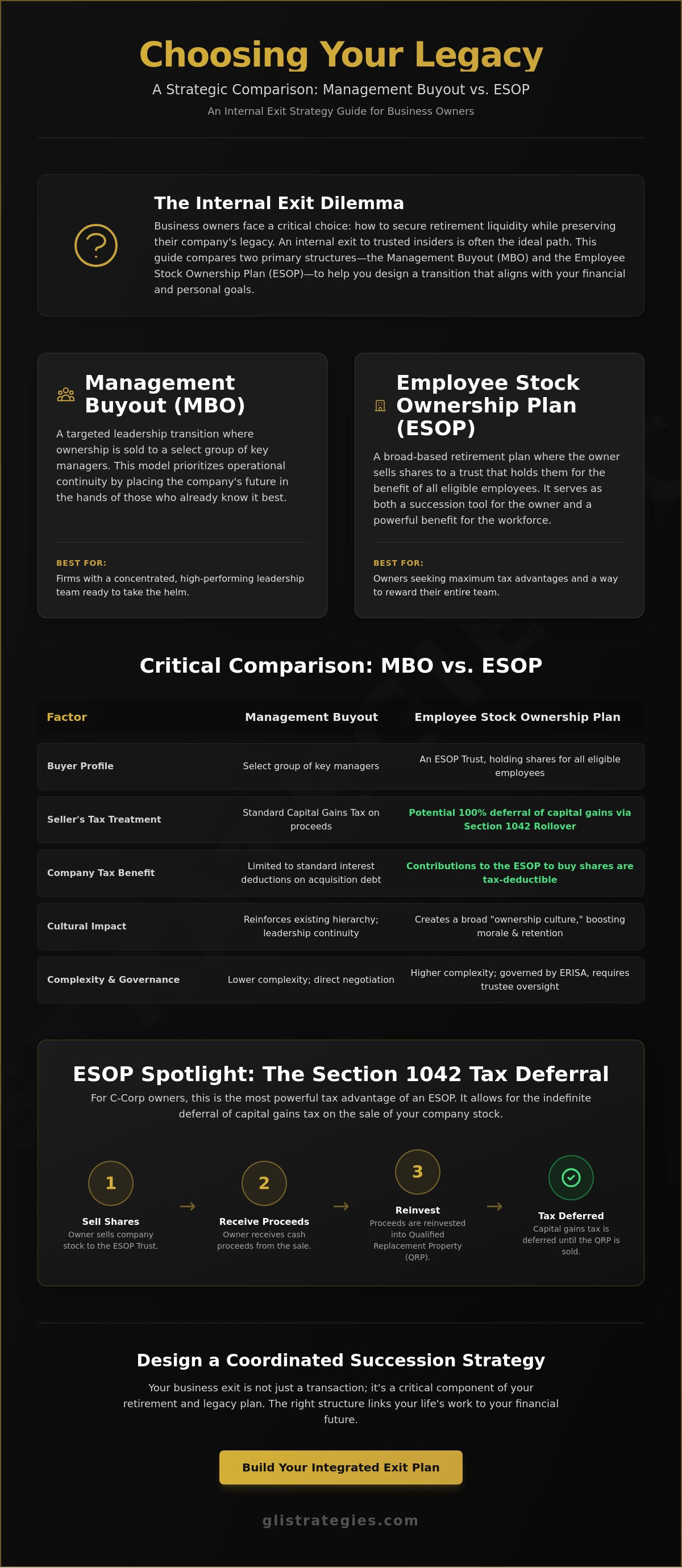
A Management Buyout (MBO) transfers ownership to a select group of key managers, while an Employee Stock Ownership Plan (ESOP) sells shares to a trust that holds them for the benefit of all eligible employees — and both paths allow a business owner to exit without selling to an outside buyer. According to the National Center for Employee Ownership (NCEO), ESOPs in particular can provide meaningful tax advantages and help preserve the company's culture and operational continuity during a transition.
For a business owner preparing for an exit, this choice is a foundational decision — one that dictates how equity will be extracted, how taxes will be managed, and how the company will be governed after your departure. Understanding the structural mechanics of each option is the first step in building a coordinated succession and income planning strategy.
Key Takeaways
Understand the structural differences between a management buyout vs. ESOP to determine which internal transition model provides the most stable foundation for your retirement income.
Explore the Section 1042 rollover mechanism, which may allow certain C-corporation owners to defer capital gains taxes when selling to an ESOP — consult your CPA and tax attorney for specifics.
Learn the essential steps for grooming internal successors and establishing a professional valuation to support a fair and orderly transfer of leadership.
Discover how to synchronize your business succession with estate and retirement planning to replace fragmented exit tactics with a unified, long-term income framework.
Analyze the transaction timelines and net liquidity profiles of each strategy to identify the most efficient path for securing your financial future without an outside sale.
The Internal Exit Dilemma: Defining Management Buyout vs. ESOP
Transitioning away from the helm of a company you've built requires more than just an exit date — it demands a structural design that keeps your legacy intact while securing your personal financial future. Many owners find themselves weighing a management buyout vs. ESOP as they seek to fund their retirement without involving outside private equity. This choice is not merely operational. It is a foundational decision that dictates how your wealth will be extracted and how the company's internal architecture will evolve after your departure.
The right answer rests on the intersection of your long-term income goals, your desire for employee participation, and the specific composition of your leadership team. By coordinating these elements, a potentially complex exit can become a stable framework for long-term stewardship — one where the sale of your firm is not the end of the journey, but the engine that powers your next chapter.
What Is a Management Buyout (MBO)?
An MBO is a targeted leadership transition where ownership is transferred to a specific group of key managers. This model prioritizes the continuity of existing operations by placing the company's future in the hands of those who already understand its inner workings. A Management Buyout is typically best suited for firms with a concentrated group of high-performing leaders who have both the vision and the commitment to guide the company forward. By selling to those already invested in the firm's success, you help ensure that the core values and operational standards you established remain the guiding force of the organization.
What Is an ESOP (Employee Stock Ownership Plan)?
An Employee Stock Ownership Plan (ESOP) operates as a broad-based corporate retirement plan governed by the Employee Retirement Income Security Act (ERISA). Instead of selling to a few individuals, the owner sells shares to a trust that holds them for the benefit of all eligible employees. This creates a dual-purpose vehicle: it provides a meaningful retirement benefit for the workforce while serving as a flexible succession tool for the owner. Because an ESOP is a qualified retirement plan, it may offer unique tax advantages that can preserve more capital for the selling owner — though the suitability of those advantages depends on the company's corporate structure and the owner's individual tax situation, which should be evaluated with a qualified CPA and attorney.
How to Evaluate the ESOP Pathway for Your Retirement
Choosing an ESOP creates a private internal market for your business interest where one might not otherwise exist. This structure allows you to sell all or a portion of your shares to a trust, which then holds them for the benefit of your employees. For many owners, this mechanism provides a reliable path to liquidity without the need to court outside competitors or private equity firms. By establishing this internal market, you maintain the company's independence while systematically converting your business equity into assets that can support your personal retirement income.
The impact on company culture is often profound. When employees become stakeholders, their alignment with the firm's long-term success tends to deepen, which frequently leads to higher retention and improved operational engagement. This collective stewardship helps ensure the business remains a stable engine of growth, protecting the legacy you've built. However, deciding between a management buyout vs. ESOP requires a careful analysis of your specific goals for both your team and your post-exit lifestyle.
The Tax Advantages of the ESOP Structure
One of the most compelling reasons to consider an ESOP is the potential to minimize or defer capital gains taxes on the sale of your shares. This is primarily achieved through the Section 1042 rollover. Under Section 1042 of the Internal Revenue Code, selling owners of C-corporations may defer capital gains taxes indefinitely by reinvesting sale proceeds into qualified replacement properties (QRP) — a provision that has remained a cornerstone of tax-advantaged succession planning. Additionally, the company can make tax-deductible contributions to the trust to facilitate the share purchase, which may allow the business to fund your exit using pre-tax dollars. The applicability of these benefits depends on your corporate structure and individual circumstances, and should be reviewed with your CPA and tax attorney before proceeding.
Operational Realities and Fiduciary Duties
While the tax benefits can be significant, an ESOP introduces a higher level of regulatory oversight. A trustee must be appointed to act as a fiduciary for the employee participants, ensuring the plan is managed in their best interest. This includes an annual professional valuation to determine the fair market value of the shares, a process governed by the Department of Labor's Employee Benefits Security Administration (EBSA).
Owners must also plan for repurchase liability — the company's obligation to buy back shares from employees when they leave or retire. A business generally needs a stable payroll and consistent profitability to support these future cash requirements. Evaluating these factors is essential to determining whether the structure is sustainable for your specific firm.
Annual ESOP contribution limits are set by the IRS and updated periodically — your CPA can confirm the current thresholds for your plan year.
Compensation limits and highly compensated employee (HCE) thresholds also affect plan design and should be reviewed with your plan administrator.
The DOL's guidance on "adequate consideration" governs how shares must be valued, making an independent, qualified appraiser a non-negotiable requirement.
How to Structure a Management Buyout (MBO) Without a Bank
While an ESOP utilizes a trust-based framework for broad participation, a management buyout focuses on the surgical transfer of ownership to a select group of key leaders. When comparing a management buyout vs. ESOP, many owners find the MBO attractive because it allows them to hand-pick their successors. However, the primary challenge often lies in the management team's lack of liquid capital. Solving this requires a shift from traditional bank lending to a seller-financed architecture that prioritizes long-term stability over an immediate cash-out.
A structured MBO typically follows a deliberate progression of steps to ensure the foundation remains solid throughout the transition:
Grooming Successors:Identifying and mentoring leaders who possess both the technical skill and the entrepreneurial mindset to steward the firm.
Professional Valuation:Establishing a fair market price that respects your legacy while ensuring the debt service is sustainable for the new owners.
The Seller Note:Acting as the lender by accepting a promissory note, which allows the management team to pay for the business over time using future company profits.
Transition Planning:Designing a multi-year handoff where authority is transferred in stages, protecting the company's operational integrity.
Income Integration:Coordinating the buyout payments with your personal retirement planning to create a steady, predictable cash flow during the transition period.
Financing the MBO: The Strategic Use of Seller Notes
In a bank-free MBO, you essentially serve as the financial architect of your own exit. By utilizing a seller note, you provide the necessary capital for the management team to acquire their equity. This approach requires balancing the team's financial commitment with your own risk tolerance. Establishing an interest rate on the seller note that reflects current market conditions creates a professional lending environment that encourages disciplined management. Your attorney and CPA should help structure the note to ensure it is legally sound and tax-efficient.
To protect your estate, it is common to integrate life insurance into the buyout agreement. This helps ensure that if a key manager passes away or the business faces a crisis, your retirement income stream remains protected. The goal is to build a protective barrier around your future cash flow — one that does not depend solely on the performance of any single individual.
Maintaining Control During the Transition
Retaining oversight while your team earns their equity is a critical component of a successful MBO. You do not simply hand over the keys; you implement a governance structure that allows you to monitor performance and step in if the business deviates from its strategic path. This coordinated oversight helps prevent common pitfalls like aggressive cost-cutting or sudden shifts in company culture that could jeopardize the buyout payments. By maintaining a seat on the board or a consultative role, you provide the steady guidance needed to bridge the gap between your leadership era and theirs — protecting both the company's reputation and your financial interests throughout the duration of the note.
Management Buyout vs. ESOP: A Critical Comparison
Evaluating a management buyout vs. ESOP requires a careful analysis of how each structure interacts with your long-term income vision. While both paths facilitate an internal exit, they differ significantly in their architectural complexity and the speed of execution. An MBO is often a more direct, private negotiation between you and a handful of trusted leaders. In contrast, an ESOP is a highly regulated corporate retirement plan that involves a broader group of stakeholders and a formal regulatory framework. Choosing between them is not about finding a universally "better" model — it is about selecting the tool that best aligns with your retirement income needs and the legacy you wish to leave behind.
Tax Efficiency and Net Liquidity
The financial impact of your choice often centers on the tax treatment of the sale proceeds. An ESOP may offer the advantage of the Section 1042 rollover, which can allow you to defer capital gains taxes if you reinvest in qualified replacement properties — preserving more of your capital for income planning. An MBO is typically treated as a standard capital gains event, though the structure of a seller note can spread the tax liability over several years, providing a more predictable cash flow profile. When evaluating estate planning implications, an ESOP can be more complex to integrate but may offer substantial opportunities for tax coordination. Your CPA and estate attorney should evaluate both paths against your specific balance sheet.
Flexibility and Post-Exit Involvement
Your desired level of involvement after the sale is another pivotal factor. In an MBO, you have the flexibility to stay on as a senior advisor or board member with a high degree of personal influence over your successors. This personal continuity is why many business owners prefer the MBO model — it feels like a natural extension of their mentorship rather than a clean break. An ESOP requires you to step back further, as the trustee takes on the fiduciary responsibility for the plan. While you can still serve on the board, the regulatory framework limits your direct operational control. If you are ready to explore which structure fits your specific needs, the 7 Pillars of Income Planning framework can help map your exit to your broader financial goals.
Can You Combine an MBO and an ESOP?
Yes — a hybrid succession model is possible and, in some cases, strategically advantageous. An owner might sell a majority stake to an ESOP trust to capture the Section 1042 tax deferral benefits while simultaneously allowing key managers to purchase a separate class of equity directly. This approach rewards the entire workforce with an ownership stake while ensuring your top-tier successors have a significant personal financial commitment to the company's future performance. The complexity of a hybrid structure requires careful coordination among your legal, tax, and financial planning professionals before execution.
Coordinating Your Business Exit with the 7 Pillars of Income Planning
The transition of a business is a defining moment in a founder's life, yet treating it as an isolated transaction often results in a fragmented financial landscape. A successful departure requires a holistic blueprint where the sale of your firm is not the end of the journey, but a structural engine designed to power your next chapter. By coordinating every element of your financial life — business succession, income planning, and estate planning — you replace fragmented decision-making with a stable, unified framework.
The 7 Pillars of Coordinated Income Planning provide that framework. Rather than treating your business exit as a standalone event, the 7 Pillars approach evaluates the collective impact of each financial decision on your long-term income, tax efficiency, and legacy. When these elements are integrated, the result is a resilient plan that honors your past achievements while securing your family's long-term stability.
Coordinating Business Exit with Retirement Income
A successful succession strategy ensures that the cash flow generated from your business sale aligns precisely with your lifestyle requirements in retirement. Whether your exit involves an ESOP structure or a management-led purchase, the proceeds from your sale need to be thoughtfully positioned to provide a steady, predictable income for the decades ahead. Many couples should plan for the possibility of a retirement spanning 30 years or more, according to research from Fidelity— which means the income planning decisions made at the point of sale can have consequences that extend far beyond the transaction itself.
Arizona's Community Property Context
For business owners in Arizona, local legal realities add an important layer of complexity to any succession plan. Arizona's community property laws mean that a business interest is often considered a joint asset, making spousal involvement and proper titling critical to a valid transfer. Coordinating these legal realities with your estate planning helps protect your family's wealth across generations and ensures the transition remains stable. Your attorney should review the specific documentation requirements for any business transfer in Arizona before you proceed.
Protecting Your Legacy with Estate Coordination
Protecting family wealth across generations requires more than a successful sale. It demands a protective stance that links your business succession to comprehensive estate planning and, where appropriate, life insurance structures. This integration helps ensure that the wealth you've generated remains a stable foundation for your heirs, shielded from unnecessary erosion. Designing this legacy is a serious responsibility that benefits from a coordinated approach across legal, tax, and income planning disciplines.
Designing Your Unified Succession Strategy
Deciding between a management buyout vs. ESOP is a pivotal choice that shapes the structural integrity of your retirement. Whether you prefer the surgical precision of a management-led purchase or the broad-based tax advantages of an ESOP, your exit should be integrated into a wider framework of income and estate protection. A standalone transaction often leaves future wealth exposed to fragmentation; a coordinated plan helps ensure your legacy remains a stable engine for your family's security.
By aligning your business sale with your long-term cash flow needs, you transform a complex transaction into a harmonious financial foundation — one that reflects the same deliberate care you applied to building the company itself.
Ready to explore how your business exit can be coordinated with your broader income plan? Request a Coordinated Succession Planning Review to begin building a unified strategy for your transition.
Frequently Asked Questions
Is an ESOP better than a management buyout for a small business?
It depends on the firm's scale and the owner's vision for the workforce. ESOPs generally require a larger, stable workforce and consistent profitability to justify the administrative and regulatory costs. For smaller firms with a lean leadership team, a management buyout often provides a more direct and cost-effective path to transferring ownership without the complexity of a federally regulated retirement plan. The right answer depends on your specific circumstances and should be evaluated with your CPA and attorney.
How long does it take to set up an ESOP vs. an MBO?
Establishing an ESOP typically requires six to twelve months because it involves extensive structural design, trustee appointment, and regulatory compliance. A management buyout is often more efficient, usually taking three to six months to finalize. This shorter timeline is possible because the transaction is a private negotiation between the owner and key managers, avoiding the lengthy filing processes required for qualified retirement plans.
Can I combine an ESOP with a management buyout?
A hybrid model is possible. An owner might sell a majority stake to an ESOP trust for potential tax advantages while allowing key managers to purchase a separate class of equity directly. This approach can reward the entire workforce while ensuring top-tier successors have a meaningful personal stake in the company's future. The complexity of this structure requires close coordination among legal, tax, and planning professionals.
What are the main tax benefits of selling my business to employees?
Selling to an ESOP may allow owners of C-corporations to defer capital gains taxes by utilizing a Section 1042 rollover, subject to specific eligibility requirements. Additionally, the company may be able to deduct its contributions to the ESOP trust, which can allow the business to fund the exit using pre-tax dollars. A management buyout does not offer these specific federal incentives, though it can be structured with seller notes to manage the owner's tax liability over time. Consult your CPA and tax attorney to evaluate which structure is appropriate for your situation.
What happens if the management team can't afford to buy the business?
If the management team lacks the necessary liquid capital, the owner typically facilitates the sale through a seller note — acting as the lender and allowing the team to pay the purchase price over several years using the company's future earnings. These payments can be coordinated with your broader income planning to help ensure your lifestyle remains stable while the new leadership earns their equity through performance.
How does an ESOP affect the day-to-day management of the company?
An ESOP does not typically change the day-to-day operations or the existing management hierarchy. Your leadership team continues to make operational decisions, while an appointed trustee handles the fiduciary duties of the shareholder trust. This structure allows you to maintain the company's culture and stability while providing employees with a meaningful stake in the firm's long-term growth and success.
Do I need a business valuation for both an MBO and an ESOP?
A professional business valuation is essential for both pathways to establish a fair market price that withstands regulatory and tax scrutiny. For an ESOP, an independent valuation is a legal requirement under ERISA and must be performed annually. In an MBO, the valuation helps ensure the debt service is sustainable for the successors while providing the owner with a fair return on their life's work.
How does business succession planning in Arizona differ from other states?
Arizona's community property laws create unique requirements for business owners that do not exist in many other states. Because a business interest is often considered a joint asset, the spouse's involvement and consent are critical to a valid transfer. Coordinating these local legal realities with your estate planning helps protect your family's wealth and ensures the transition remains stable across generations. Your Arizona-licensed attorney should review the specific documentation requirements for your situation.
Next Steps
Explore how business succession fits into the 7 Pillars of Wealth Stewardship at Global Investment Strategies.
Review your current business valuation and succession timeline with your CPA and legal team before committing to a structure.
Schedule a Coordinated Income Planning Consultation to evaluate how the proceeds from an internal exit can be structured for long-term income and estate protection.
References
National Center for Employee Ownership (NCEO) — ESOP Overview
Internal Revenue Service — Employee Stock Ownership Plans (ESOPs)
U.S. Department of Labor — Employee Benefits Security Administration (EBSA)
Global Investment Strategies — 7 Pillars of Coordinated Income Planning
Global Investment Strategies provides educational information regarding retirement income strategies. Global Investment Strategies and its representatives are not fiduciaries, tax advisors, CPAs, Certified Financial Planners, or attorneys. This material is for educational purposes only and should not be construed as legal, tax, or investment advice. Always consult with qualified professionals regarding your specific situation before making any financial decisions.