


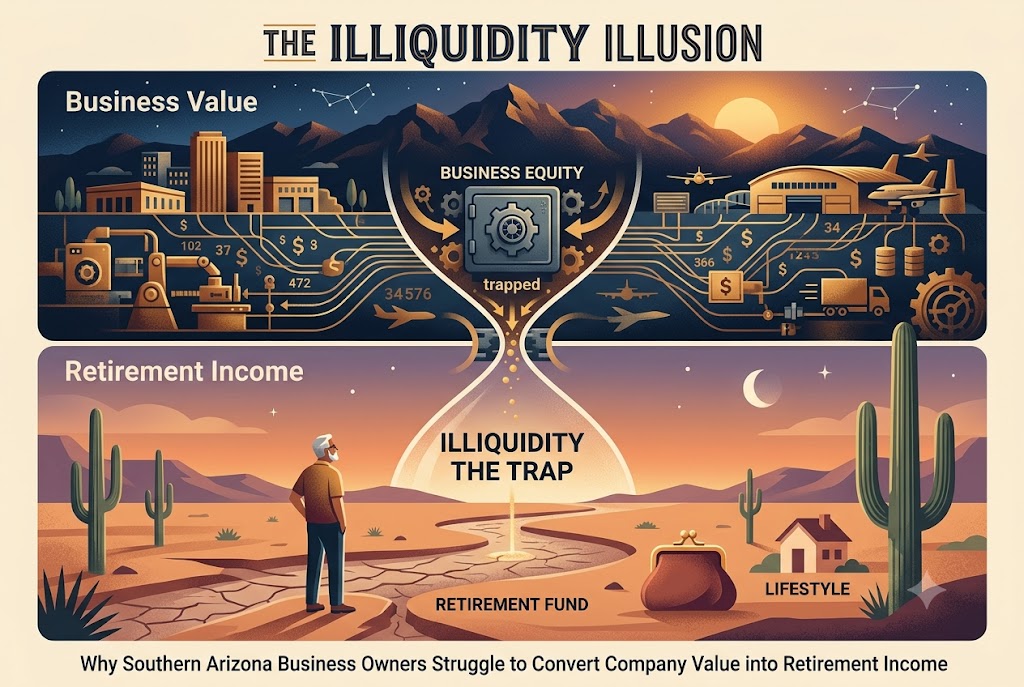
The Illiquidity Illusion: Why Tucson Business Owners Struggle to Convert Company Value into Retirement Income
For decades, founders in Tucson’s defense corridors, aerospace logistics, and advanced engineering sectors have poured every ounce of surplus cash back into their enterprises. On paper, the results are impressive: millions in corporate equity, specialized machinery, real estate holding companies, and proprietary intellectual property.
But when a founder approaches their mid-60s, a harsh financial reality sets in. You cannot buy a retirement lifestyle with warehouse equipment, and you cannot fund a legacy with corporate goodwill.This is the Illiquidity Illusion. Many business owners mistake high enterprise value for personal financial security, only to discover that pulling that value out of the company without destroying it is one of the most complex structural challenges they will ever face.
The Core Friction: The Structural Liquidity Gap
Most business advisors focus heavily on wealth accumulation—how to scale, win contracts, and maximize EBITDA (Earnings Before Interest, Taxes, Depreciation, and Amortization). Very few understand wealth coordination—the operational plumbing required to move value across the boundary line from the corporate balance sheet to the family’s private estate.
When a high-net-worth owner decides it is time to step back, they generally face three distinct exit pathways in the Southern Arizona market. Each carries massive execution risks:
The Internal Succession (Family or Key Employees): Passing the torch to a child or a long-time management team is emotionally rewarding, but it rarely comes with an immediate, multi-million-dollar cash event. Instead, the retirement income is tied to a promissory note, meaning the founder’s lifestyle remains entirely dependent on the next generation’s ability to run the company effectively.
The Strategic Third-Party Sale: Selling to a competitor or an institutional private equity group provides immediate liquidity, but it forces the founder into a massive, single-year tax event. Without advanced structural planning, state and federal tax authorities can claim up to 40% or more of the hard-earned purchase price right at the closing table.
The Orderly Liquidation: Winding down operations and selling off individual corporate assets (fleet vehicles, real estate, machinery) is often a worst-case scenario. It liquidates the company at fire-sale prices, completely erasing the value of the "brand equity" and operational systems built over a lifetime.
Weathering the Transition: The Multi-Year Structural Runway
To convert trapped corporate value into a disciplined, predictable monthly paycheck that outpaces inflation, an owner cannot treat an exit as a single transaction. It requires a multi-year coordination runway.
1. Asset Isolation & Business Continuation (36 Months Out)
High-net-worth owners should look to separate their operating business from their commercial real estate well in advance. By holding the real estate in a distinct legal structure and leasing it back to the operating entity, the founder creates a permanent, independent income stream that continues to pay the family long after the business itself is sold. To map out how these transitions coordinate with your broader wealth goals, explore our comprehensive framework on How to Create Retirement Income from a Business.
2. Tax Insulation & Capital Gains Optimization (24 Months Out)
For tech, bioscience, and aerospace founders scaling out of regional innovation hubs, optimizing for Section 1202 exclusions can be a massive game-changer. Under the IRS Qualified Small Business Stock (QSBS) Guidelines, eligible individuals can exclude up to 100% of their capital gains—up to a $10 million cap or 10 times the stock's adjusted basis—upon an enterprise sale. Alternatively, structuring the transition as an installment sale can spread the tax liability over a decade, keeping the founder from being pushed into the highest federal tax brackets all at once.
3. Mitigating Sunset Vulnerabilities (12 Months Out)
Compounding the challenge of business exit timing is the evolving regulatory climate. Following the structural expiration of provisions established by the Tax Cuts and Jobs Act (TCJA), high-net-worth families are navigating compressed individual tax brackets and a severely lowered unified estate tax exemption threshold. Discover how to build balanced cash flow frameworks that guard against these shifting thresholds by checking out our Income Planning Guide.
4. The Personal Income Pivot (Execution Phase)
True security means decoupling your daily livelihood from your former company's daily risks. A structured income plan utilizes the cash proceeds of the business transition to seed a distinct, buffered portfolio—ensuring that personal lifestyle expenses are completely insulated from market volatility or industry-specific downturns. Read about our process for transitioning from a paycheck to a portfolio on our Retirement Planning & Wealth Stewardship page.
Discipline Over Speculation
A business owner’s greatest asset is the discipline that allowed them to build their company from scratch. When transitioning into retirement, that same discipline must be applied to protecting what was built.
An institutional-grade income plan ensures that your business exit isn't just a finish line for your company, but a secure, permanent foundation for the next generation of your family.