

Quick Answer: In the U.S., traditional private placement life insurance is generally structured as a variable policy with separate investment accounts. A non-variable advanced insurance approach is a different structure that some families evaluate when they want greater predictability for a portion of capital rather than additional market exposure.
Why the Distinction Matters
Entrepreneurs and high-net-worth families often already have substantial exposure to business interests, real estate, private equity, and other growth-oriented assets. When they explore advanced life insurance, the structure of the policy affects how that portion of capital behaves. Traditional private placement and a non-variable approach are not the same thing.
Traditional Private Placement (Variable)
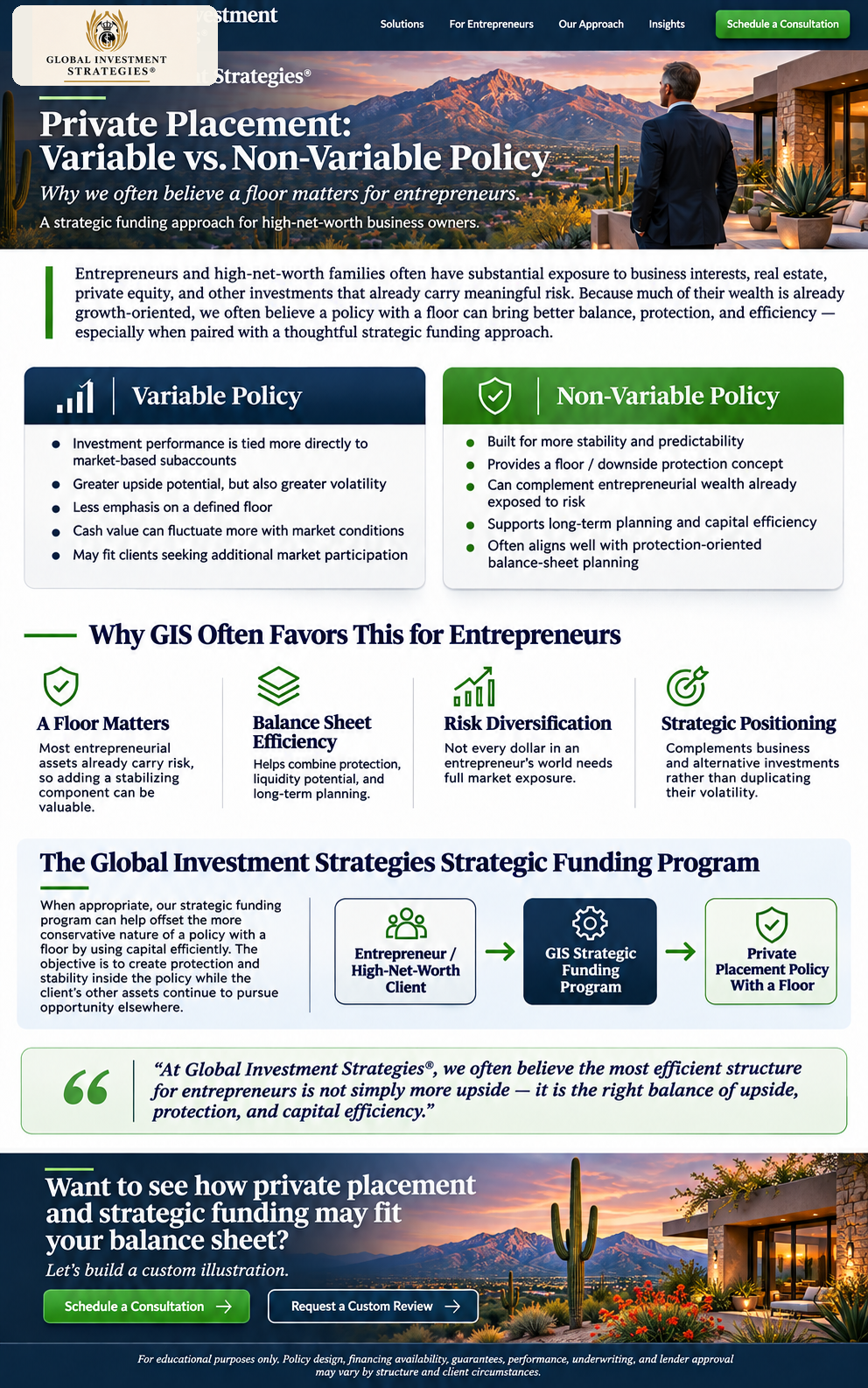
In the U.S., traditional private placement life insurance is generally built around a variable universal life policy and separate investment accounts. Investment performance is tied more directly to the underlying accounts. This structure can offer access to sophisticated investment strategies and greater upside potential, but it also means the cash value can fluctuate with market conditions. It may fit clients who want additional market participation inside the policy and who meet the qualification and suitability requirements.
Non-Variable Advanced Insurance Approach
A non-variable design is a different structure. It is built for greater stability and predictability relative to a variable separate-account policy. Depending on the specific contract, it may include a crediting floor or other contractual features. It can complement assets that already carry business or market risk rather than adding another layer of investment volatility. Any guarantees are limited to the terms of the policy and the claims-paying ability of the carrier. It is not risk-free.
Policy charges, loans, and withdrawals can still reduce cash value even when a crediting floor prevents a negative index credit in a given period. The floor applies to the crediting mechanism; it is not a promise that overall policy value cannot decline.
Where a Floor Can Fit
For some entrepreneurs the question is not whether to stop taking risk. It is whether every dollar of the financial plan still needs to carry the same exposure as the operating business and other upside assets. A non-variable structure is one approach some families evaluate for the portion of capital they want positioned for greater predictability. Life insurance and estate planning reviews are typically coordinated with existing advisors.
A Short Example
A business owner in Southern Arizona has significant value concentrated in the company and related real estate. After reviewing liquidity, underwriting, and family objectives, the conversation turns to whether a non-variable design could provide greater predictability for part of the plan while the operating assets continue to provide upside. The decision depends on the specific contract, the owner’s insurability, available liquidity outside the policy, and the family’s long-term goals. There is no single structure that fits every situation.
Funding Considerations
Whether the policy is variable or non-variable, the family must decide how premiums will be paid. Direct funding uses the family’s own resources. Premium financing, where appropriate, involves a lender and introduces interest, collateral, and repayment obligations. Any comparison should show actual cash commitment, costs, and the net benefit projected to remain for heirs. Financing does not automatically reduce overall cost.
Questions to Discuss with Your Advisors
- Is the policy under consideration a variable private-placement structure or a non-variable design?
- What exactly does any crediting floor or guarantee protect, and what does it not protect?
- How do policy charges affect cash value even in a zero-credit year?
- What is the total funding commitment under direct pay versus financing?
- Does the strategy actually solve a problem the family has?
Engineered, Not Simply Sold
These cases involve carrier selection, underwriting, policy architecture, funding analysis, and coordination with the client’s existing legal and tax advisors. Growth where you want it. A floor where you need it.
If you believe you may qualify, contact Global Investment Strategies for a complimentary private consultation. We will tell you candidly whether it fits your objective.
This article is for education only and is not individual investment, tax, or insurance advice.